Saturday, January 1, 2011

God Jul!


This year I spent Christmas away from home for the first time. Instead of returning to Canada, I spent the holidays with my friend Fennia in western Sweden. I did miss some Canadian and family traditions, for instance they don't show all the same Christmas specials here (No Rudolph, No Christmas Story, No Christmas episode of the Flintstones even!) Sweden does have its own Christmas viewing traditions though, and I watched Kalle Anka, or "Karl Duck" which is what they call Donald Duck here. He is arguably more popular than Mickey Mouse (or Musse Pygg "Energetic Mouse"). A lot of the clips on Kalle Anka were familiar from my childhood though, which was a nice touch. 


It was extremely snowy in Vastgotland, the area where I stayed. I heard that Toronto only received a little snow, but there were several feet of snow in Sweden, and more has continued to fall. Above is the guest house I stayed in at my friend's farm. 


Sweden is sometimes regarded as the least religious country in the world, but Christmas is still enormously important. It's mostly celebrated in a secular way, about cultural traditions rather than Jesus. I did attend a Christmas morning service for the first time in life. The service was in Swedish, so I didn't understand too much, but it was an interesting mix of old Sweden (The building was hundreds of years old, lit only by candles) with new (The minister was female and instead of telling the traditional story of Jesus' birth, she told a story about Astrid Lindgren.) 


While the weather was incredibly cold during Christmas (-15 celsius) it was relatively sunny. I think that Vastgotland is perhaps the most beautiful part of Sweden I've been to. Unlike the South, which is extremely flat, Vastgotland has hills and forests, and looks like what I imagined Sweden would look like. The architecture in the area is also very traditional and Nordic. 


These were some of the shortest days of the year, and this picture was taken shortly before noon. The sun just doesn't get any higher in the sky than this.

My favorite part of Christmas in Sweden was the food. For the Christmas julbord we had julskinka (Ham), turkey, meatballs (which I helped to make), herring, cheese, two kinds of sausage, mashed potatoes, and Jonssons frestelse, which I used to hate but it's now my favorite. It's a potato gratin with anchovy, and is a very strange and interesting flavor. 


Above is a symbol of Sweden's large and influential Jewish community, so powerful that every house displays a menorah in each window! Either they are menorahs or a Swedish Christmas candelabra, but it's funny to see something that would be identified very differently in North America. 


My friend lives on a pig farm, one that raises piglets. I had the chance to see the farm firsthand, which was alternately horrifying and delightful. Seeing the pregnant sows was somewhat horrifying. I was surprised at how large they were, although many were friendly and curious to see me. Also horrifying was the smells, a collection of some of the worst odors I've ever experienced. Each room in the pig farm smelled bad in a different way, according to the particular combination of urine, feces and pigs located there. The worst was the room where sick piglets were quarantined, which was such a noxious smell I had a vertigo sensation. After an hour though I couldn't really notice the smell anymore, and I was surprised by how strongly the smell clung to me and my clothes after I left.


The piglets themselves were very cute. They were shy of people, and scattered when we came. They mostly just nurse from their mothers or pile under the heat lamp. Interestingly, the piglets themselves don't smell bad, they smell rather like babies do. The piglets are very soft as well. The above piglet was a feisty one, and quite the screamer. The piglets varied in color, most pink but others gray, black or a combination of all three. Piglets are undoubtedly cute, but seeing them live first hand and what they grow up to become kills some of the cute piglet fantasy. They are livestock, not pets.


Seeing the piglets did not make me any more squeamish towards meat. Farming is not always pleasant, but seeing livestock in the flesh strips any romantic notions of pastoral farm animals. Farming is an industry now, and the animals are its products. The pigs leave brief, but not terrible lives, before they end up as food for us. The very same day I saw the piglets, I ate ham from a pig-shaped platter. I don't feel bad about eating pigs, they would probably do the same to us if given the chance.

Tuesday, December 21, 2010

Berlin: The Happiest Place on Earth


So Berlin sometimes looks like a post-apocalyptic wasteland, but it is still full of fun and good times! It's a strange city, it's very modern, but you can still sense the scars of Nazism and Communism. But Berlin did not let authoritarianism keep it down for long, at it's heart, it is a party town. 


While I was there, the city was preparing for Christmas. Christmas markets lined all the major streets selling candy, gluhvin (hot spiced wine), hats, and other Christmas paraphernalia. At Alexanderplatz, there was a large carnival with rides. In this area the city had a very festive feeling. In other areas, the city was populated by people who looked as though they might cry at any moment. 


Some East German dourness may remain in Berlin, as you can see above, but for the most part the city is very integrated. You cannot tell exactly when you are in the East or West sections of the city, and there is nearly no recognizable impression left from the wall. There is a cultural difference though, in East Berlin many people do not speak English, as they were instead taught Russian as their second language prior to reunification. This was my first time meeting people who didn't speak English in Europe. I was surprised at my own reaction, I felt as though these people should know English, we're in the developed world after all. Being in Europe has made me aware of the privilege of being fluent in English. Thankfully though, my friends Marc and Ina are native German speakers, and they smoothed out any rough translation patches. 


I stayed with my friend Ina in Kreuzberg, which is the Williamsburg, Sodermalm, Queen West, "insert trendy neighborhood here" of Berlin. The difference between Kreuzberg and the aforementioned is that Kreuzberg retains some of its original appeal, despite gentrification.


Kreuzberg has a large Turkish population, and is home to a Turkish market. I had never eaten Turkish food before, but in Berlin I was exposed to it in a big way. I ate at a certain Turkish bakery half-a-dozen times during my stay, but the bakery was open 24/7 and everything was just a euro. Turkish cuisine was similar to Greek or Lebanese, heavy on feta, spinach, and sesame. Kreuzberg also had a lot of Vietnamese restaurants, a product of Cold War era forced migration from Vietnam to the DDR.


Berlin also has the world's best kebab, called doner locally. I had kebab at one renowned street vendor, and it was delicious, with chicken, grilled vegetables, feta, and two kinds of sauce. Food in Berlin is also fantastically cheap, never once did I spend more than $10 at a meal. (Okay, I did once, but only once.)


The most notable thing about Berlin visually is that there is graffiti everywhere, some simple tags, other elaborate illustrations. A lot of the graffiti or street art is political, above is a "Free Mumia" poster, taking up the case of a death row inmate in Pennsylvania. There is also considerable anti-Nazi graffiti in Kreuzberg, as there are still clashes between Nazi and anti-Nazi street gangs.


Berlin is generally very leftist, and fascism isn't tolerated. However, with increased immigration there is increased nativism. There are two groups of skinheads in Berlin. The first are immigrants from the former USSR who gained German citizenship by claiming it through their great-grandparents. Some of these immigrants have formed street gangs that are anti-Semitic and anti-Turkish. Other skinheads are German nativists, who oppose any immigration or multiculturalism. However, these conflicts weren't visible in day to day life other than through the street art.


The largest collection of street art is the East Side Gallery, which is the largest stretch of the Berlin wall that still remains. They have preserved it as it was in 1989, and the art on the walls dates to that time. If anyone graffitis over the work, it is repainted to its original state. It seems odd in a city of constant change that street art would be preserved, but it is a large part of East Berlin's history. 


 There were many artists who worked on the wall, and a great variety of styles, but most of the art falls into general themes of philosophy, universal humanism, and parodies of Soviet communism. The above quote seems to be a fitting description of Berlin's restlessness, but it's funny that even on the Berlin wall, writing would be in English. 


It's incredible to have as much outdoor art as Berlin does. Walking through the city you are constantly immersed in it. But there is also indoor art. 


Here are some reindeer that have been fed magic mushrooms as part of an art project. The artist's intent was "Blah Blah ancient Sanskrit texts, blah blah perception, blah reindeer mice and canaries, blah you can pay 1000 euros to sleep in the stable and drink reindeer pee." In the artists defense, the reindeer pee may contain hallucinogenic properties. 


It was supposed to be art as an experiment. Neither the audience nor the artist was informed which group of reindeer was fed the fly agaric mushroom. However, one group of reindeer definitely acted like they were tripping. They were hyperventilating, licking themselves, and staring in the mirror. I wonder if the SPCA would frown on drugging reindeer for art, but apparently the reindeer will also consume the mushroom in the wild when foraging. I thought it was fun to watch the reindeer act silly, but my friend Marc said it wasn't art. 


If that wasn't art, this wasn't news. The frontpage story in Berlin was the tale of Flocky, the blind and deaf poodle that was left out in the snow. While this is certainly a sad story, does it really demand front page coverage? And to be shown as a breaking news bulletin on the metro TVs? Berliners love dogs though, and so the tale of Flocky was very much the zeitgeist. Dogs are allowed anywhere in Berlin, on trains, in restaurants, in expensive boutiques. I like it because I think it's fascinating to see dogs in people places, but I cringed when I saw a man hold a terrier in one arm while examining suede shoes. Dogs are great fun, but they will pee indoors. 


It wouldn't be a vacation in Germany without some cringing at inappropriate references to the Nazi past, and here at the Mercedes-Benz Christmas display Santa appears to be giving a Heil Hitler salute. Was this accidental? Intentional? Ironic? Offensive? I don't know, but I doubt Santa is a Nazi, he's Jewish! 


It was great fun to spend the week preceding Coca-Colamas in Berlin. (The Coca-Cola corporation has bought and reserved all rights to the holiday formerly known as Christmas within German borders.) Now I prepare to spend Christmas in Sweden, my first Christmas away from home.

PS: I learned something funny about German people. Despite their clean reputations, Germans do not shower daily. In fact, Germans only bathe when they perceive themselves to smell. They do this so they may save water, or because they enjoy filth. I now feel that the French are unfairly judged for their hygiene, when it is Germans that are the culprits. I skipped a few showers in Berlin after I noticed I was the only person showering, I wanted to feel a little more German.

Tuesday, December 14, 2010

In which I celebrate a made-up Swedish holiday


The Swedish are a greedy people. They crave celebration so much that they decided they could not wait two weeks until Christmas, and instead must have a holiday immediately. So they made up Sankta Lucia Day. My understanding is that it was a pagan ritual that celebrated candles and female virginity, to show resilience in the face of the dark winter. When the Catholic missionaries arrived, they too enjoyed candles and female virginity, so they retooled the holiday to be about a Greek martyr. When Catholicism was expelled from Sweden, they just loved the holiday too much to get rid of it, so they continue to celebrate a Greek Catholic saint with candles. Oh well, I mostly like it for the dinner.


My nation hosted a gasque (a Swedish word for formal dinner party) to celebrate Lucia. My friend Patrik stepped in to be my last minute prom date (although I forgot the corsage), and then we were off to enjoy some genuine Swedish festivities.


I apologize for being such a tourist and being so tacky as to photograph what I ate, but it was herring! The appetizer was two (TWO!) types of herring, served with knackebrod, a potato, and a beet salad. One herring was ginger flavored, the other mustard. Herring was much better than I expected, the texture was meaty and not at all offensive. It really wasn't so different from sushi. I think North Americans are overly squeamish about herring, although I've heard that even Swedes hate fermented herring (which I have yet to try.)


The main course was lamb and potato au gratin. Traditionally, Swedes eat a dish called Jonsson's Delight around this time of year, which is a potato casserole made with anchovies. The first time I ate it was rather traumatic, but I've grown to love and hate the thing. Most Swedish food is offensive at first, but it lures you in with repeated tastings.


Finally, they served a saffron cheesecake for dessert. Lots of desserts are saffron flavored for the holidays, even the glugg. Swedish cheesecake (ostkake) is different from New York style cheesecake. Swedish cheesecake has a grain to it, and is similar to marscapone cheese rather than cream cheese. I like all kinds of cheesecake though.

One odd thing is that there are all new beverages for Christmas, including Christmas beer, seen above. Christmas beers are darker and maltier usually, and each brewery produces its own. They're only around for the holidays, and then come back in new labels as Easter beer. They also make Julmust, which is like a spiced Coca-Cola that everyone buys over the holidays. One strange drink is "mumma", which tastes like Julmust and beer mixed together (that might be what it is.)


There is also new Christmas candy, my favorite of which is Juleskum. Skum translates to mean 'foam', but sounds a lot like our word 'scum'. They are little strawberry flavored Santa marshmallows. I ate this bag in one sitting.

Now that Lucia is over, it's on to Christmas, which I will also be spending in Sweden. I like Christmas season a lot in Sweden because it fits to my personal ideal - overwhelmingly commercial and entirely irreilgious. Sweden definitely gives North America a run for its money in sheer commercialism, they even make you buy new beer and soda! I like how Christmas infiltrates every part of Swedish life, which is notable in a country that has the highest proportion of non-religious people. I can certainly relate, because I grew up with secular Christmases that were about Santa rather than Jesus, and the only lessons were from TV specials about vague "Christmas miracles" and "the spirit of the season".

My last month in Europe will definitely be busy, with Berlin, Norway, and Gothenberg on the tentative itinerary.

Tuesday, November 30, 2010

Sex and Catfood

One thing unique to the Swedish psyche is the intersection of sex and pet food products. This kind of convergence between the erotic and catfood has not been seen in other cultures, as other anthropological surveys have surmised. In this post, I attempt to make sense of this phenomenon, and I will adopt an anthropological distance to maintain objectivity. I warn my more genteel readers, from here on it gets a little blue.


Here we see our first instance of the erotic marketing of catfood. Funny, I never thought it looked that good anyways. 


I believe it was Daryl Bem who theorized that the exotic becomes erotic...

Oh my...  Now they have taken it too far! How is this legal?!

Clearly there is a dark side to the sexualization of catfood, leading to earlier and earlier development of sexuality being pushed on youth. I can't imagine how the conscience of the Swedish people can rest with this travesty. 


Of course, not all catfood revolves around sex in Sweden. Opticat Prime here appeals to fantasies of bionic pets with cybertronic abilities. Certainly he must have Terminator vision. 
Of course they do have dogs in Sweden too, and yes, they are allowed to eat. Above is a concise but accurate description of Orlando. (I've been there, trust me, there is not a lot to say.) 


So yes, that is what interested me most in Sweden the past week. Puns of catfood names. Lest you think I am not providing educational content, below I share a prime example of Swedish-American relations

This is what America is to Swedes. Not purple mountains majesty, nor amber waves of grain. Not the bustle of New York City or the influence of Hollywood. Not the wide open spaces of all that stuff in between New York and Hollywood. No. America is donuts. What I find most incorrect about this whole scene is that donuts are Canadian! 


Donuts may have arguably originated in America, but they have been thoroughly appropriated by Canadians. Canadians consume the most donuts in the world per capita, and have the most donut stores. Swedes are not large donut consumers, but seem to appreciate the novelty. Only time will tell if donuts are spared the rampant sexualization that has befallen the catfood industry.


Friday, November 19, 2010

Winter Comes to Sweden


It has been some time since I last wrote, but I was ill, and while I was convalescing I had to write a final paper, but now I offer an update now that we are deep in the grips of winter.

It is very cold and snowy here, and while I know winter being a Canadian and all, it has been snowy ever since the beginning of November, which is earlier than I'm accustomed to. The snow does brighten the landscape up, which is a plus seeing as the sun sets at 3:30pm now.


One of the more unusual features of Uppsala is its very large and old cemetary in the middle of town. Swedish cemeteries look different from their North American counterparts. There are no rolling, grassy lawns. Instead all the plots are very orderly and each plot is covered with gravel neatly raked with a small garden of perennials. In winter the care taken to the cemetery is less apparent, but it is still beautiful.


Here in the cemetery, just as elsewhere in life, size denotes importance. Some monuments are impressive like the obelisk above, others are much more humble. Strangely, most of the graves in this section of the cemetery date from the 19th century, but they are still visited regularly with flowers and candles.


On All Souls' Day, everyone visits their ancestors' graves and lights candles. I went to the cemetery that night with friends, and it is a very strange sight to see, each grave marked by candles, some with many, and groups of mourners wandering in the darkness. Unfortunately I didn't have my camera with me, so I cannot share that magic moment. 


It is funny to see that even in the cemetery in winter, on a bare iron fence, things are living. On the curlicues of the fence at one grave, lichens were colonizing the iron. 


Lest you think I spend ALL my time creeping around cemeteries (I limit my time to an hour a day, tops!) I do normal activities as well. I was recently in Stockholm, at a garden market, where vendors apparently did not learn that pumpkins are supposed to be sold BEFORE Halloween. I suppose buying a discount pumpkin the week after Halloween is a good value, but unlike discount Halloween candy, or Bowing Day gifts, pumpkins won't keep till next year. I feel as though I should educate Swedes about Halloween, because currently they are doing it at a remedial level. 


The flower market in Stockholm was incredibly beautiful, and something I just came across.


I had previously written that Copenhagen is more outgoing and fun than Stockholm. I went back into Stockholm to see if my perception was truly correct, and I still feel it's true. Stockholm is very beautiful, but has an air of formality and propriety throughout the city. Copenhagen was in parts, genuinely dirty. There were people who were truly trashy. While I've had a more positive experience with Swedes, Copenhagen is more of a party town. Partying requires a certain level of filth and disregard for order, and Stockholm never loses its composure. 


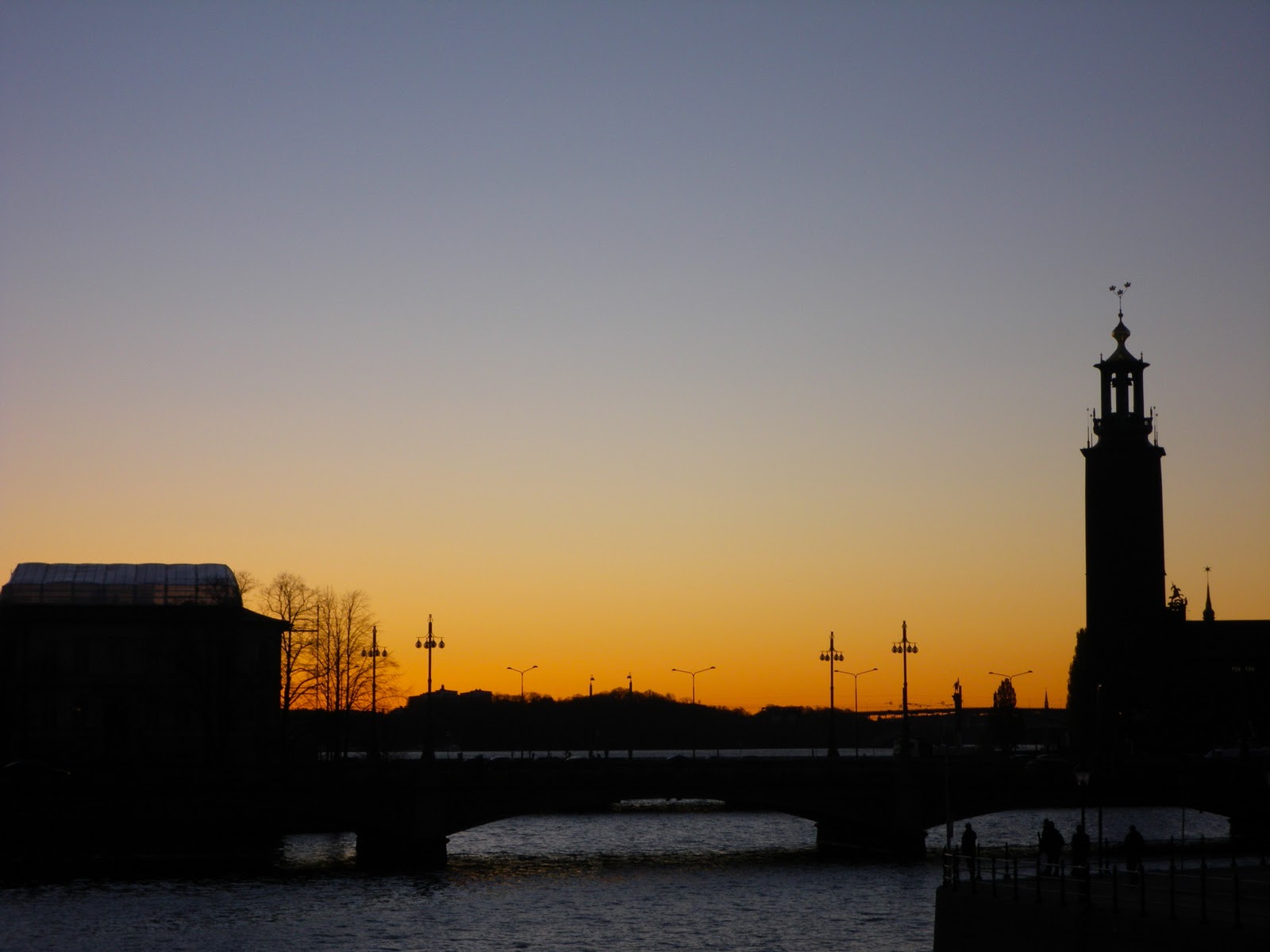
But it is pretty. This picture above was taken at 4:30pm. The sun now sets a full hour earlier. It also noticeable now that the sun never gets very high in the sky. At noon it never seems to rise high enough, and then just begins setting. 

Strangely, the lack of sun hasn't bothered me here. Usually I have a lot less energy in the fall even in North America, but currently I'm getting less sunlight than Toronto gets during winter solstice, and I feel no urge to sleep 14 hours a day.


Now that it's winter, Jul season begins. As in North America, the Christmas season begins here the first of November. Also, it is highly commercialized and consumerist, so don't feel like you've got that on lock America. One Jul product is vinglogg, a wine spiced with cinnamon and clove, and served warm. It's very sweet, but it's tasty. However, unlike regular wine I don't think it has the same intoxicating feeling, despite its 15% alcohol content. 


Another Swedish culinary tradition I tried recently is Fiskbullar, or fish balls. The name alone put a stop in my throat, but I figured it is worth trying. I like meatballs and I like fish, so why not some meatball made out of fish? The fishballs come in various sauces: tomato basil, mustard, dill, shrimp. I tried the lobster flavor, which suffice to say tasted nothing like anything in the crustacean family. I don't know if Swedish people know what lobster is, but I'll tell you what it isn't: wet cardboard. I tried zesting up the paste that the balls came in to little avail. The balls themselves are soft and mealy. They are not chewy (something I was afraid of.) They weren't traumatizing, but I don't think I would eat them again.


As Swedish winter continues, as I still ride my bike everywhere. Above is an idea of the conditions I have to contend with. It is easy to see why Scandinavians found themselves in Minnesota and the Dakotas. Snow and flatness is familiar to them. While the local accent is more charming than any Minnesota braying, parts of Sweden looks not unlike any snowy part of the Midwest. 


One positive image to end on. Even in Sweden, the tropics are not so far away.  


PS: Recently, this author received comment that this blog is among the least pretentious a certain reader had ever read. I was dismayed to learn I'm not doing my job right! I am trying to be more pretentious, like a true blogger. Maybe later I'll upload some Godard film stills juxtaposed with Joy Division quotes. I promise I'll continue to become more pretentious until I'm genuinely insufferable!